
The Psychology of Panic Selling
It often begins quietly: a red trading session, followed by another. Negative headlines emerge, and anxious conversations start—“the market is crashing, better exit now.”
CORE MONEY & INVESTING
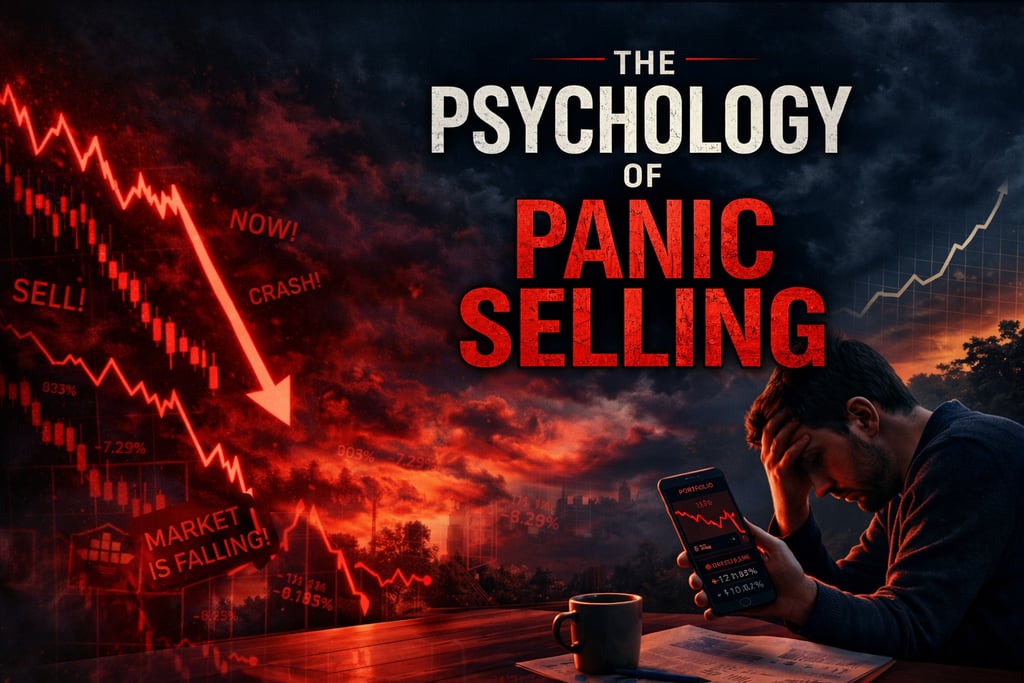
It often begins subtly. A string of red trading sessions. Negative headlines dominate the financial wires. Conversations among investors turn apprehensive: the market is headed for a crash, better to exit while one still can.
In the realm of money and investing, this is a familiar script. Yet, succumbing to it can prove costly.
Have you ever watched your portfolio decline and felt an overwhelming impulse to sell—not because your financial goals had shifted or your analysis had changed, but simply because fear had taken hold?
What started as a calculated long-term allocation suddenly appears precarious. The mind races with questions: What if the decline deepens? What if capital is eroded further? Would it not be prudent to cut losses and seek safety?
At that juncture, rational investment discipline gives way to primal human response. Panic selling is less about market mechanics and more about behavioural finance. The human brain, hardwired over millennia for survival, interprets financial loss as an existential threat. The pain of losing money, as behavioural economists have long documented, outweighs the pleasure of equivalent gains—a phenomenon known as loss aversion.
Consequently, investors act to alleviate immediate discomfort, often liquidating positions at precisely the wrong moment. This is not a failure of financial literacy, but a triumph of emotion over logic.
History shows the typical aftermath. Markets eventually stabilise and recover. Those who sold in panic watch from the sidelines as values rebound, only to confront the sting of regret.
The pertinent question, therefore, is not whether markets will experience corrections—they invariably do—but how one chooses to respond when they occur.
Seasoned investors are not immune to fear. They witness the same drawdowns and unsettling news flow. Their edge lies in restraint: they pause before acting, reaffirm their original investment thesis, and recognise that volatility is an inherent feature of equity markets, not a signal to abandon strategy.
Decisions taken in the heat of panic frequently carry lasting consequences, crystallising losses that could have been avoided through patience and discipline.
The next time the indices turn sharply lower and the internal voice urges an immediate exit, it pays to step back. Breathe. Reassess whether the impulse stems from reasoned analysis or raw emotion.
In investing, the greatest risk is rarely the market itself. More often, it is one’s own psychological biases.
Final Thought Markets will periodically test resolve and patience. Long-term success hinges on a single discipline: the ability to remain composed when sentiment turns fearful and others are rushing for the exits.ur text here...